FabOps™ is now generally available as a Microsoft Fabric workload

What it does, and what that means for organisations running Fabric at scale
Most Microsoft Fabric estates do not start with a governance problem. They develop one.
It happens gradually and for good reasons. A second business unit gets its own workspace. A pipeline is built to solve something urgent and nobody documents it. A semantic model gets certified, then the person who owned it moves teams. Capacity consumption creeps up and the reasons are distributed across a dozen workloads that each looked reasonable on their own.
Nothing is broken. But increasingly, nobody can answer straightforward questions about the estate as a whole. What is actually running. Whether the numbers people are reporting on refreshed successfully this morning. Who can see what. Where the capacity went.
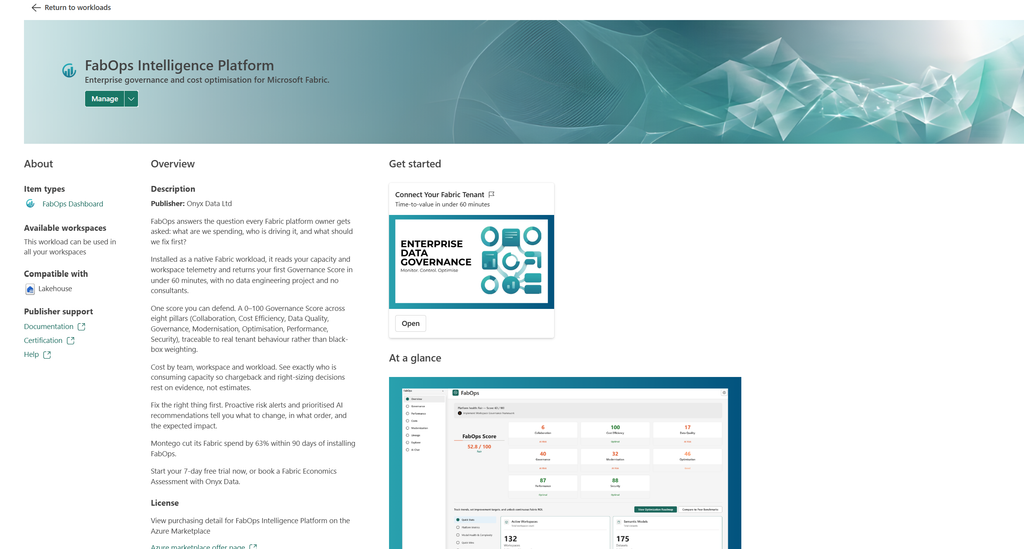
FabOps™ Intelligence is built to answer those questions continuously, and as of today it is generally available as a Microsoft Fabric workload.
Fabric Workload, and why that matters
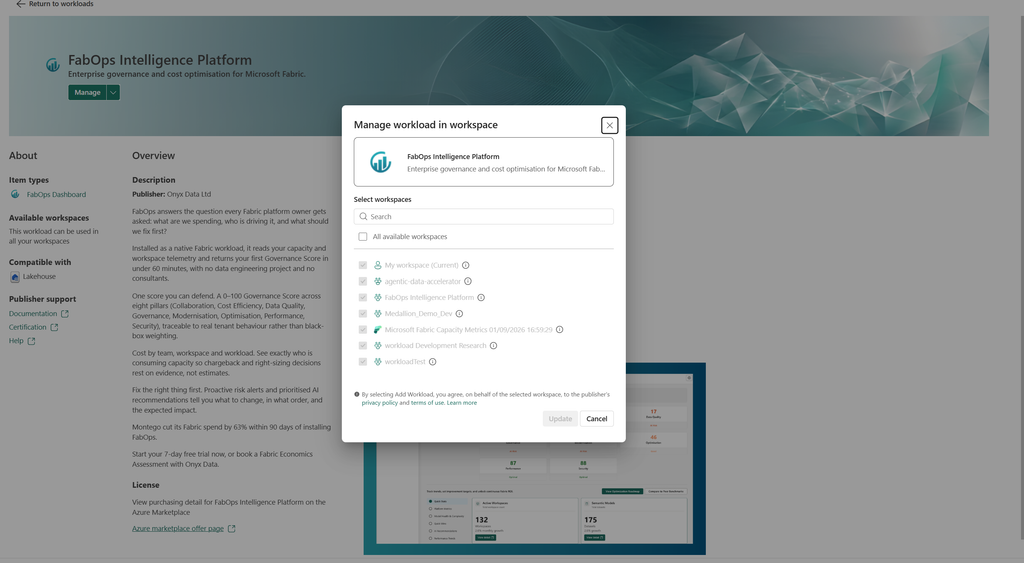
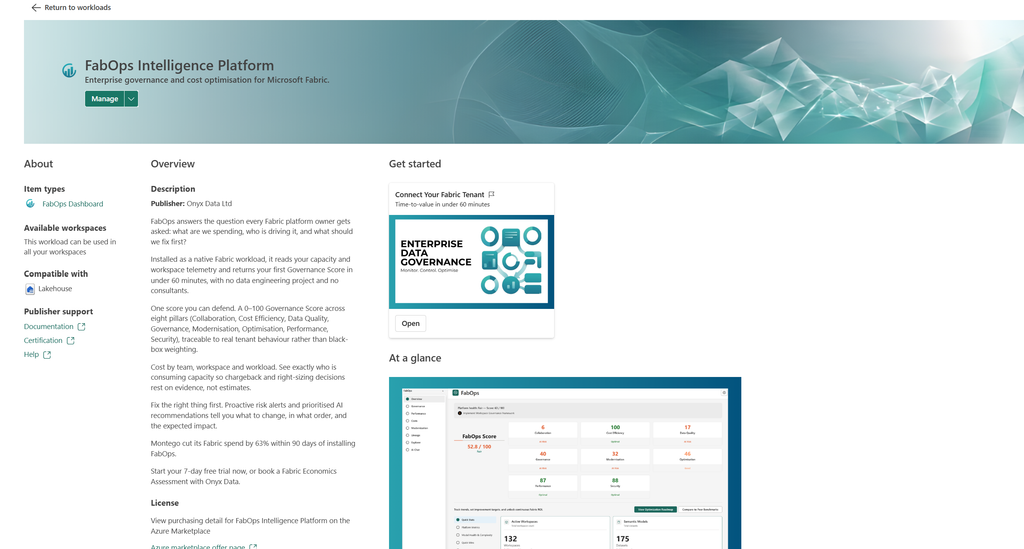
FabOps™ installs from the Workloads Hub in Microsoft Fabric. It runs in your own tenant, alongside the estate it observes.
That is not a deployment detail. It is the difference between a governance tool a security team can approve and one they cannot.
Governance tooling has an awkward property: to tell you anything useful, it needs broad visibility of your environment. When that tooling is an external application, broad visibility means moving telemetry about your estate outside your tenant, and the conversation moves from the platform team to the security team, and frequently stops there. We have seen organisations abandon governance tooling entirely for this reason, not because they disagreed with the need, but because the architecture could not clear internal review.
Running as a workload in Fabric removes that conversation. The estate is observed where it lives.
What the workload does
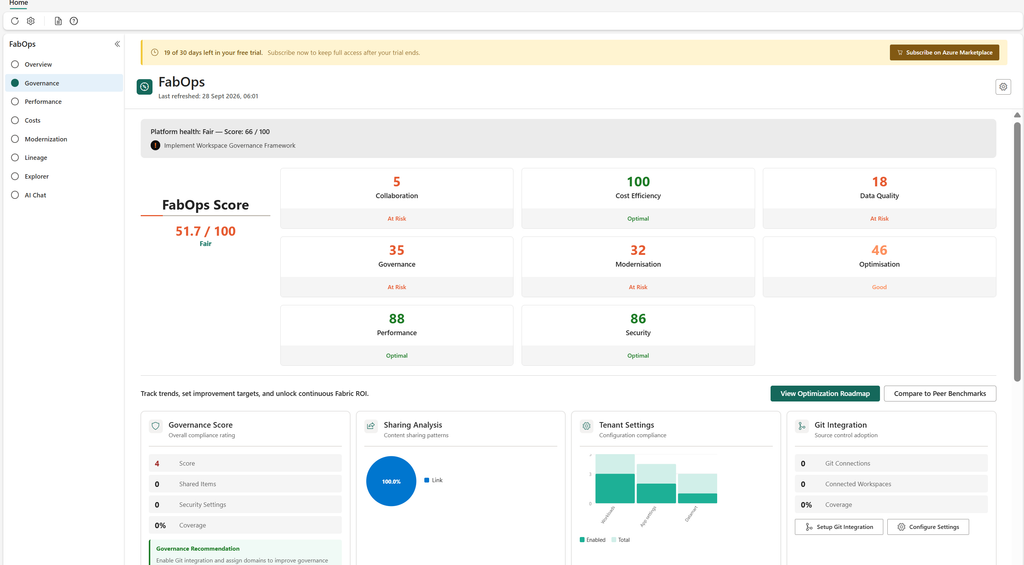
Governance scoring. FabOps™ scores your estate continuously against a governance framework covering workspace structure, access, certification, documentation and operational health. The value is not the number on any given day. It is the trend: whether the estate is improving or drifting as it grows, and which specific things to fix next. Governance stops being an annual audit exercise and becomes a measurement.
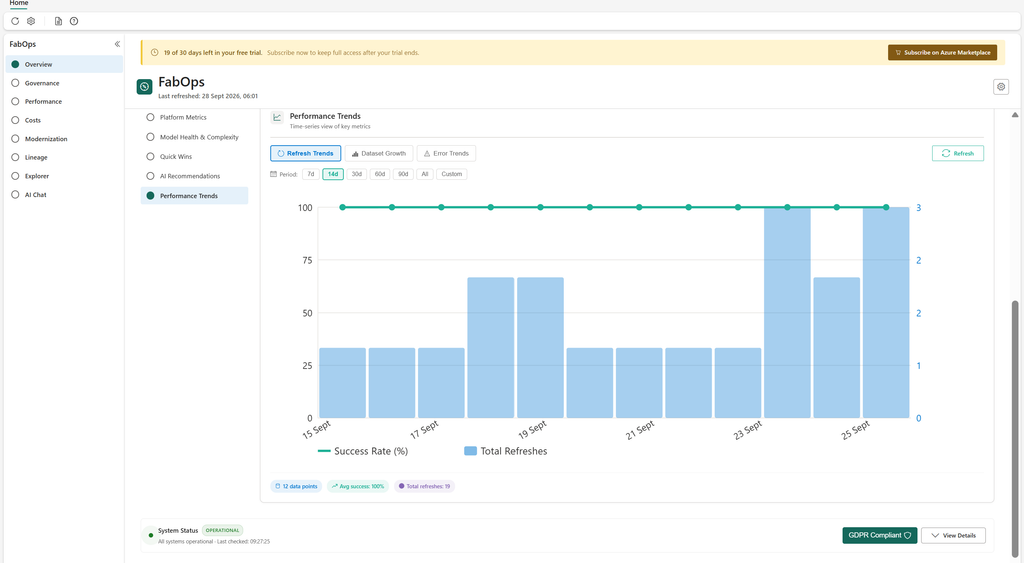
Refresh and pipeline monitoring. Scheduled refreshes and pipelines are monitored across the estate, with alerting by exception. The practical effect is that the platform team learns about a failure from FabOps™ rather than from a business user asking why yesterday’s figures look wrong. Failures surface with enough context to act on rather than as a notification that something, somewhere, did not run.
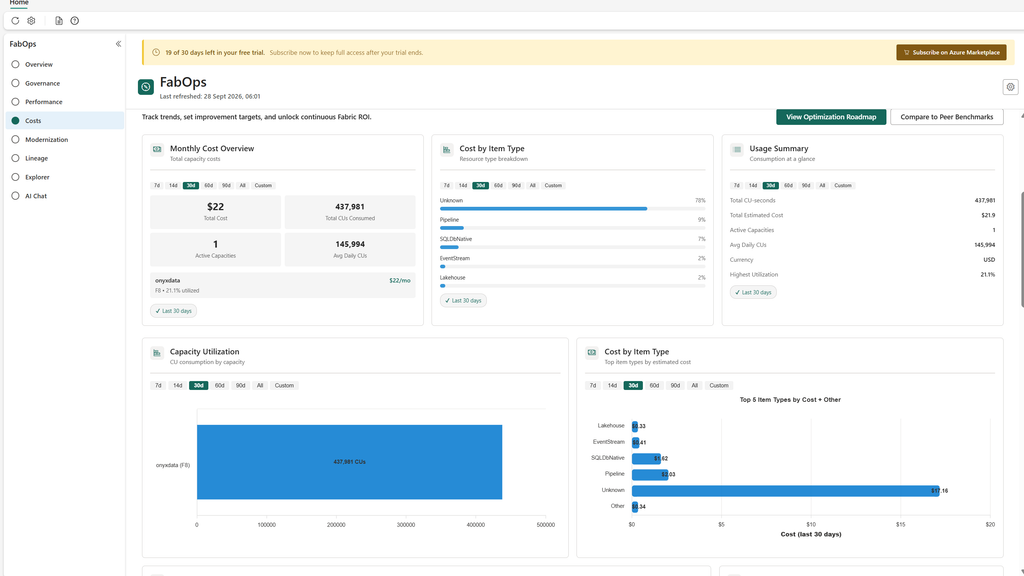
Capacity and cost visibility. Fabric capacity is consumed by everything in the estate, which makes it easy to pay for and hard to attribute. FabOps™ shows what is consuming capacity, which workloads and workspaces are driving it, and where consumption is growing. That turns a monthly invoice into something a platform owner can act on and a finance business partner can understand.
Access governance. Access across workspaces is monitored rather than assumed. Who has access to what, where permissions have been granted outside the intended model, and where access has accumulated over time as people changed roles.
Estate inventory and health. A single view of what exists across the estate: workspaces, items, owners, and their operational condition.
What this means for organisations
For platform teams, the day changes shape. Less time spent discovering problems through other people’s complaints, more spent on the queue of things that actually need attention. Alerting by exception means the estate reports its own condition rather than waiting to be checked.
For finance and platform owners, capacity spend becomes explainable. “Consumption is up twelve per cent and here is what drove it” is a different conversation from “consumption is up twelve per cent.”
For security and compliance teams, two things change. Access across the estate becomes visible and reviewable rather than reconstructed on request. And because the workload runs in tenant, adopting it does not require an exception to the data movement policy.
For data leaders, governance becomes measurable. A score that moves over time is something you can put in front of a board, target, and show progress against. That is materially harder with point-in-time assessments that go stale the week after they are produced.
For organisations preparing for AI on their data, this matters more than it did eighteen months ago. Agents and natural-language analytics inherit whatever condition your estate is in. An agent answering questions from an ungoverned estate will answer confidently and inconsistently, and the trust cost of that is high and difficult to recover. Governance is not a prerequisite anyone enjoys, but it is the thing that makes the next layer safe to build.
In practice: Montego Pet Nutrition
Montego Pet Nutrition is a South African pet nutrition manufacturer, established in 2000, running Microsoft Fabric as its production analytics platform across manufacturing, sales and supply chain. As the estate grew, the data platform team had no unified view of what the business held, limited lineage visibility, and data quality checks that relied on manual, hand-run work.
FabOps™ was live against Montego’s estate with its first governance scores produced within 60 minutes of installation. Over the engagement, scheduled refresh reliability was sustained at 99.9%, and the automation of previously hand-run governance checks materially reduced the manual workload on the platform team.
“We were looking for a single, unified tool to manage governance, cost, and performance in Microsoft Fabric. FabOps™ stood out as a one-stop-shop solution,” said Nico Botes, Data Platform Manager at Montego. “Alerts on outages and scoring functionality helped us make faster decisions and hit our KPIs. I’d recommend FabOps™ to any Fabric user—it’s lightweight, centralized, and packed with tools that simplify oversight.”
The full Montego case study is available on the Onyx Data website.
“Fabric workloads are how partners bring specialised capability directly into the experience customers already use. Onyx Data’s FabOps™ workload is a strong example of that model: governance and operational visibility running inside the customer’s own tenant, built by a partner with deep Fabric expertise. We’re pleased to see it reach general availability.” — Dipti Borkar, VP , Microsoft IQ and OneLake, Microsoft.
Getting started
FabOps™ is available now in the Workload Hub in Microsoft Fabric, and is listed on Microsoft Marketplace.
Installation is self-service and does not require a professional services engagement. A trial is available so you can score your own tenant and see the state of your estate before deciding anything. In our experience, the first score is usually the most interesting conversation, because it tends to surface things people suspected but had no way to demonstrate.
If you would like to walk through your results with us, we are happy to do that.
Find out more: fabops.ai · Microsoft Marketplace
Onyx Data is a Microsoft Fabric Featured Partner and Microsoft Solutions Partner for Data & AI. We build FabOps™ Intelligence and deliver enterprise Fabric engagements across the UK, Europe and the Middle East.
Related Articles