Fabric Won’t Fix Your Mess. Your First 90 Days Will.

Modernising Without Rebuilding Your Technical Debt
For Heads of Data and Directors of Analytics, the pressure to “get onto Fabric” is real. The current stack often spans Azure Data Factory, Synapse, Databricks, and Power BI, each with its own pipelines, permissions, and quirks. On paper, Microsoft Fabric promises to unify this into a single, integrated experience; in reality, it can just as easily become “Technical Debt 2.0” if you lift‑and‑shift old patterns into a new platform.
The risk is not just cost overrun or missed deadlines. Poorly planned migrations create a tangle of ad‑hoc workspaces, overlapping domains, and duplicated data that makes it harder—not easier—to govern and evolve your estate. The organisation ends up with more surface area to secure, more pipelines to maintain, and more confusion about which version of a metric is the right one.
Data Sprawl and Integration Fatigue in the Pre‑Fabric World
Many data leaders are already juggling multiple tools and integration points: ingestion orchestrated in ADF, transformation logic in Synapse or Databricks, semantic models in one place, reports in another, and governance stitched together with spreadsheets and tribal knowledge. Each new use case tends to add another pipeline or workspace rather than rationalising what exists.
This “integration fatigue” shows up as slow delivery, fragile jobs, and opaque ownership. When something breaks, teams spend days hopping between services to trace lineage and permissions. When the business asks for a new AI or analytics initiative, the conversation is as much about platform constraints as it is about value. Fabric seems attractive precisely because it promises to collapse these moving parts into a single experience.
Why Fabric Alone Is Not Modernisation
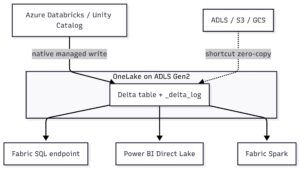
Fabric centralises capabilities—lakehouse, warehouse, SQL, real‑time analytics, and BI—on top of OneLake. That simplifies the technical surface, but it does not automatically resolve structural issues like unclear data ownership, ad‑hoc domain boundaries, or inconsistent security models. If anything, the speed and convenience of Fabric can accelerate bad patterns if they are not addressed up front.
Governance guidance for Fabric emphasises the importance of designing domains, workspaces, and item ownership before teams start building in earnest. Without that, you risk:
-
Workspaces that mix critical production assets with experimental work.
-
Cross‑domain dependencies that are invisible until something fails.
-
Semantic models and reports that embed their own logic instead of reusing shared definitions.
In other words, you move your mess into a faster car and then discover it is even harder to service.
The First 90 Days: Setting Zoning Laws, Not Just Pipelines
A more sustainable approach treats the first 90 days of a Fabric journey as an architecture and governance exercise, not a tools rollout. The goal is to set “zoning laws” for your data estate: clear rules about which domains own which data, how workspaces map to domains and environments, and how products are promoted from experiment to production.
Practically, that early work usually covers:
-
Domain design and workspace topology: mapping business domains to Fabric workspaces, with explicit separation of dev/test/prod.
-
Ownership and roles: defining who owns which workloads, who can publish to shared semantic models, and how access requests are handled.
-
Standards and patterns: agreeing on canonical ways to ingest, transform, and expose data products so teams don’t reinvent the wheel with every project.
By front‑loading these decisions, you reduce the amount of retrofitting and refactoring required later and give your teams a clear frame within which they can move quickly.
Designing for Governance, Not Just Performance
A Fabric platform that delivers in year three is one that bakes governance into its design from day one. That means using Fabric’s built‑in capabilities—catalog, access control, lineage, and sensitivity labels—deliberately, rather than as an afterthought. It also means aligning those features with a broader governance framework: data domain councils, change management, and incident handling.
Data lakehouse governance research highlights three recurring pillars: clear ownership, consistent controls, and continuous monitoring. In Fabric, those translate into:
-
Every dataset and data product having a named owner and domain.
-
Access patterns that default to least privilege, with self‑service routes that still respect domain boundaries.
-
Regular checks for permission drift, orphaned assets, and unused pipelines that can be retired.
When governance is treated as part of the architecture, rather than a separate programme, it becomes easier to scale without breaking things.
Avoiding “Technical Debt 2.0” in Fabric
Technical debt in modern platforms is less about old code and more about unmanaged complexity: too many ways to do the same thing, too many hidden dependencies, too little clarity about what can be safely changed. Fabric can either simplify that landscape or amplify it, depending on how intentionally you approach the initial rollout.
To avoid “Technical Debt 2.0”, data leaders can:
-
Limit the number of sanctioned patterns for ingestion, transformation, and serving, and document them clearly.
-
Use Fabric’s unified observability to track usage and performance of domains and workspaces, tuning or decommissioning assets as needed.
-
Treat semantic models and data products as first-class citizens with lifecycle management, not as incidental outputs of projects.
The objective is not a perfectly designed system, but one where you can explain the structure to a new engineer in an hour and where changes in one area do not create unexpected impact in another.
If you feel the pull to “get onto Fabric” but worry that you might be rebuilding your technical debt in a new toolset, it is worth pausing before the migration accelerates. Use the form below to request a platform architecture consultation: together we can review your existing Azure estate, sketch the right domain and workspace “zoning laws” for your organisation, and outline a 90‑day Fabric adoption plan that lets you modernise with confidence instead of moving your mess into a faster car.
Related Articles