3 Things AI Can Already Do for Your Company
3 Things AI Can Already Do for Your Company


Artificial intelligence (AI) is rapidly transforming the world, and businesses of all sizes are beginning to adopt it to improve their operations and gain a competitive advantage. AI can be used to automate tasks, improve efficiency, and make better decisions.

Here are three things that AI can already do for your company:

  1. Automate tasks. AI can be used to automate a wide range of tasks, from simple tasks like data entry and customer service to more complex tasks like financial modeling and product development. This can free up your employees to focus on more strategic and creative work.

For example, AI-powered chatbots can be used to answer customer questions and provide support 24/7. AI can also be used to automate tasks like invoicing, payroll, and reporting.

  1. Improve efficiency. AI can help you to improve the efficiency of your operations by identifying and eliminating bottlenecks. It can also be used to optimise your processes and make better use of your resources.

For example, AI-powered supply chain management systems can help you to optimise your inventory levels and reduce shipping costs. AI can also be used to optimise marketing campaigns and target customers more effectively.

  1. Make better decisions. AI can help you to make better decisions by providing you with insights that you would not be able to obtain on your own. It can also be used to simulate different scenarios and predict the outcomes of your decisions.

For example, AI-powered customer relationship management (CRM) systems can help you to identify your most valuable customers and develop targeted marketing campaigns. AI can also be used to predict customer churn and develop strategies to retain customers.

What are some real-world examples of AI in action?

Here are a few examples of how companies are using AI today:

Netflix uses AI to recommend movies and TV shows to its users.

Amazon uses AI to personalise product recommendations and optimise its supply chain.

Google uses AI to improve the accuracy of its search results and develop new products like Google Translate and Google Maps.

Walmart uses AI to optimise its inventory levels and reduce food waste.

GE uses AI to predict when machines are likely to fail and prevent costly downtime.

Real-world applications of AI and automation

Here are some specific examples of real-world applications of AI and automation:

  • Customer service: AI-powered chatbots can provide 24/7 customer support and answer customer questions quickly and accurately.
  • Marketing: AI can be used to personalise marketing campaigns and target customers more effectively.
  • Sales: AI can be used to identify leads and predict customer behavior.
  • Product development: AI can be used to analyse customer data and identify new product opportunities.
  • Manufacturing: AI can be used to automate production processes and improve quality control.
  • Supply chain management: AI can be used to optimize inventory levels and reduce shipping costs.

Real world examples of responsible AI

Here are a few examples of companies that are using AI in a responsible and ethical way:

Google AI has developed a set of principles for the development and use of AI, which focus on fairness, transparency, accountability, and social benefit.

Microsoft AI has developed a set of ethical guidelines for AI, which cover topics such as fairness, transparency, and accountability.

IBM AI has developed a set of principles for the responsible development and use of AI, which focus on trust, transparency, accountability, fairness, openness, and human values.

Uses of active machine learning in real life

Here are a few examples of how active machine learning is being used in real life:

  • Fraud detection: AI can be used to detect fraudulent transactions by analysing large amounts of data.
  • Medical diagnosis: AI can be used to help doctors diagnose diseases by analysing medical images and patient data.
  • Natural language processing: AI can be used to understand and generate human language, which is used in applications such as machine translation and chatbots.
  • Recommendation systems: AI can be used to recommend products, services, and content to users based on their past behavior and preferences.

How machine learning is deployed in real world scenarios

Machine learning models are typically deployed in real-world scenarios using a cloud-based platform such as Google Cloud Platform, Amazon Web Services, or Microsoft Azure. These platforms provide the infrastructure and tools that are needed to train, deploy, and manage machine learning models.

Once a machine learning model is deployed, it can be used to make predictions or decisions in real time. For example, an AI-powered chatbot could be deployed on a company’s website to answer customer questions. The chatbot could use the machine learning model to understand the customer’s question and generate a response.

Conclusion

AI is a powerful tool that can help businesses of all sizes to improve their operations and make better decisions. If you are not already using AI in your business, it is time to start considering how it can help you to achieve your goals.

Find out more about our services here.

Click, read, and hear more about data and artificial intelligence  with our blogs on our website.

 

Citations

https://hbr.org/2018/01/artificial-intelligence-for-the-real-world

https://www.simplilearn.com/how-netflix-uses-ai-data-science-and-ml-article

https://www.lineate.com/blog/3-ways-amazon-uses-ai-to-make-product-recommendations

Google turns to machine learning to advance translation of text out in the real world

Walmart: Using machine learning to reduce food waste

https://www.fierceelectronics.com/sensors/how-predictive-maintenance-helps-forecast-when-machine-will-fail
 

Hidden layers in a neural network?

Hidden layers in a neural network?

Why is there a need for hidden layers in a neural network?

Hidden layers are necessary in neural networks because they allow the network to learn complex patterns in the data. Without hidden layers, a neural network would be limited to learning only linear relationships between the input and output data. However, hidden layers allow the network to learn non-linear relationships, which are much more common in real-world data.

Hidden layers work by transforming the input data into a new representation that is easier for the network to learn from. This transformation is performed by a series of mathematical functions, called activation functions. Activation functions introduce non-linearity into the network, which allows it to learn more complex patterns.

The number of hidden layers in a neural network depends on the complexity of the task that the network is trying to learn. For simple tasks, a single hidden layer may be sufficient. However, for more complex tasks, such as image recognition and natural language processing, multiple hidden layers are typically required.

What is the use of multiple hidden layers in deep learning?

Deep learning is a type of machine learning that uses artificial neural networks with multiple hidden layers. Deep learning models have been shown to achieve state-of-the-art results on a wide range of tasks, including image recognition, natural language processing, and machine translation.

Multiple hidden layers allow deep learning models to learn complex patterns in the data that would be difficult or impossible to learn with a single hidden layer. For example, a deep learning model for image recognition may have one hidden layer that learns to identify basic features, such as lines and curves. Another hidden layer may learn to combine these features into more complex features, such as eyes and noses. And yet another hidden layer may learn to combine these features into even more complex features, such as faces.

By using multiple hidden layers, deep learning models can learn to identify complex patterns in the data that would be difficult or impossible to learn with a single hidden layer.

What is a hidden layer in machine learning?

A hidden layer is a layer of artificial neurons in a neural network that is located between the input layer and the output layer. Hidden layers are responsible for learning complex patterns in the data and transforming the input data into a new representation that is easier for the network to learn from.

Hidden layers work by applying a series of mathematical functions to the input data. These functions are called activation functions and they introduce non-linearity into the network. Non-linearity is necessary for the network to learn complex patterns in the data.

The number of hidden layers in a neural network depends on the complexity of the task that the network is trying to learn. For simple tasks, a single hidden layer may be sufficient. However, for more complex tasks, multiple hidden layers are typically required.

What is the role of a hidden layer?

The role of a hidden layer is to learn complex patterns in the data and to transform the input data into a new representation that is easier for the network to learn from. This is done by applying a series of mathematical functions to the input data. These functions are called activation functions and they introduce non-linearity into the network. Non-linearity is necessary for the network to learn complex patterns in the data.

Hidden layers are essential for neural networks to be able to learn complex tasks, such as image recognition and natural language processing. Without hidden layers, neural networks would be limited to learning only linear relationships between the input and output data.

Yes, more than one hidden layer makes it deep.

A neural network with more than one hidden layer is considered a deep neural network. Deep neural networks are able to learn more complex patterns in the data than neural networks with a single hidden layer. This is because each hidden layer can learn to represent the data in a more abstract way, which makes it easier for the network to learn complex relationships between the input and output data.

Deep neural networks have been shown to achieve state-of-the-art results on a wide range of tasks, including image recognition, natural language processing, and machine translation.

What is the role of neural networks in deep learning and AI?

Neural networks play a central role in deep learning and AI. Deep learning is a type of machine learning that uses artificial neural networks with multiple hidden layers to learn complex patterns in the data. AI is a field of computer science that deals with the creation of intelligent agents, which are systems that can reason, learn, and act autonomously.

Neural networks are used in a wide range of AI applications, including:

  • Image recognition
  • Natural language processing
  • Machine translation
  • Speech recognition
  • Autonomous vehicles
  • Recommendation systems
  • Financial forecasting
  • And much more!

In conclusion, neural networks are a powerful tool for machine learning and AI because they can learn complex patterns in the data without being explicitly programmed. This makes them well-suited for tasks that are difficult or impossible for traditional machine learning algorithms to solve.

Breaking News Alert!

A Comprehensive Guide to AI Technology: Types, Uses, and the Future

A Comprehensive Guide to AI Technology: Types, Uses, and the Future


Artificial Intelligence (AI)
has rapidly evolved from being a concept of science fiction to a powerful and transformative force in the real world. AI technology is revolutionising various industries and impacting our daily lives in more ways than we can imagine.

In this blog, we will delve into the different types of AI technologies, explore what AI is, who uses it, how it works, its advantages, and its promising future. 

What is Artificial Intelligence (AI)? 

At its core, AI refers to the development of computer systems that can perform tasks that typically require human intelligence. These tasks include problem-solving, decision-making, understanding natural language, recognising patterns, and even learning from experience. AI is designed to simulate human thinking and decision-making processes, making it capable of carrying out complex tasks autonomously. 

Who Uses AI? 

AI technology is not limited to a specific sector; it is utilised across various industries. For instance: 

Healthcare: AI is employed in medical diagnosis, drug discovery, and personalised patient care. 

Finance: In finance, AI algorithms are used for fraud detection, portfolio management, and algorithmic trading. 

Manufacturing: AI-driven robots and automation systems enhance efficiency and reduce errors in manufacturing processes. 

Retail: AI personalises shopping experiences, recommends products, and optimises supply chain management. 

Entertainment: AI powers content recommendations on streaming platforms and game development. 

Transportation: Self-driving cars and AI-based navigation systems are revolutionising transportation. 

Customer Service: Chatbots and virtual assistants provide efficient customer support. 

What is AI Technology, and Can it be Useful? 

AI technology encompasses a range of techniques and tools that enable machines to exhibit intelligent behaviour. These include: 

  • Machine Learning: It allows machines to learn from data and improve their performance over time. Supervised learning, unsupervised learning, and reinforcement learning are common subfields. 
  • Natural Language Processing (NLP): NLP enables machines to understand, interpret, and generate human language, facilitating chatbots and language translation. 
  • Computer Vision: It enables machines to analyse and interpret visual information from the world, making applications like facial recognition and image analysis possible. 
  • Expert Systems: Expert systems use a knowledge base to solve complex problems, making them useful in diagnostics and decision support. 
  • Neural Networks: These are algorithms inspired by the human brain, often used in deep learning to solve complex problems like image and speech recognition. 

How Does AI Work, and What Technology is Used? 

AI systems typically rely on vast amounts of data. Machine learning models are trained on this data, and algorithms identify patterns and make predictions or decisions. Neural networks, which mimic the human brain’s structure, are used in deep learning. Furthermore, GPUs (Graphics Processing Units) and TPUs (Tensor Processing Units) are used for the rapid computation required for AI tasks. 

What is AI Technology, and Demand in the Future? 

AI technology is poised to play an increasingly central role in our lives. In the future, we can expect to see AI: 

In Healthcare: AI will assist in more accurate disease diagnosis and drug discovery. 

In Education: Personalised learning experiences and virtual tutors will be made possible by AI. 

In Finance: AI will provide more advanced risk assessment and financial planning. 

In Smart Cities: AI will contribute to better traffic management and urban planning. 

In Environmental Sustainability: AI will help monitor and combat climate change. 

In Space Exploration: AI-driven rovers and spacecraft will aid in exploring distant planets. 

What is AI Technology, and How is AI Changing the World? 

AI is fundamentally changing the world in multiple ways: 

  • Automation: AI is automating routine and manual tasks, enhancing efficiency and reducing errors. 
  • Personalization: AI tailors’ content and services to individual preferences, from Netflix recommendations to targeted advertising. 
  • Healthcare: AI is assisting in early disease detection and improving patient care. 
  • Education: AI is providing personalised learning experiences and accessible education. 
  • Security: AI aids in cybersecurity by detecting threats and vulnerabilities. 
  • Sustainability: AI contributes to energy conservation and environmental monitoring. 

What are the Advantages of AI Technology? 

The advantages of AI technology are numerous: 

  • Efficiency: AI can process vast amounts of data quickly and accurately. 
  • Accuracy: AI reduces human error in tasks like data analysis and pattern recognition. 
  • Cost Savings: Automation leads to cost savings in various industries. 
  • Personalization: AI provides tailored experiences for users. 
  • 24/7 Availability: AI-powered systems can work round the clock without fatigue. 
  • Innovation: AI drives innovation in multiple sectors, from autonomous vehicles to medical advancements. 

What is the Future of AI Technology? 

The future of AI technology is incredibly promising. As AI algorithms continue to improve and become more accessible, we can anticipate: 

  • Wider Adoption: More industries will integrate AI into their operations. 
  • Ethical Concerns: AI ethics and regulations will become increasingly important. 
  • Quantum Computing: Quantum computing will boost AI capabilities to new heights. 
  • Human-AI Collaboration: AI will complement human abilities, leading to new opportunities. 
  • Solving Complex Problems: AI will tackle global challenges, including healthcare and climate change. 
 In conclusion, AI technology is a rapidly evolving field with wide-ranging applications and a promising future.  

Want to find out more?

Interested in learning more about AI and how we Onyx Data use it to transform businesses? Contact us today to get in touch with our team of experts. Whether you have specific questions, need additional details, or want to explore customised data solutions tailored to your needs, we’re here to assist you every step of the way. Embrace the future of data-driven success with Onyx. Reach out now!

Excel in the 21st Century: Innovations for Data Analysts

Excel in the 21st Century: Innovations for Data Analysts

Microsoft Excel continues to be a vital tool for analysts and professionals across industries. It has evolved from a simple spreadsheet program into a comprehensive data analysis and visualisation platform, empowering users to extract valuable insights from complex datasets. In this blog post, we’ll explore the current state of Excel and the future of Excel analysts while highlighting the benefits of acquiring these essential skills.

The Power of Excel for Data Analysis

Enhanced Data Analysis Skills

Microsoft Excel’s prowess in data analysis is well-established. Its intuitive interface allows users to manipulate data with ease, making it an ideal choice for data crunching, sorting, and filtering. Excel’s array of functions and formulas simplifies complex calculations, making it a valuable tool for identifying trends and patterns in data.

Q: How has Excel’s data analysis capabilities evolved over time?

A: Over the years, Microsoft has introduced advanced features like Power Query, Power Pivot, and Power BI integration, providing analysts with more powerful tools for data extraction, transformation, and visualisation. These enhancements enable users to perform more complex analyses and generate deeper insights.

Improved Efficiency

Efficiency is a cornerstone of any modern analyst’s work. Excel streamlines this aspect by automating repetitive tasks, which saves time and enhances productivity. The ability to set up automated workflows, utilise macros, and employ conditional formatting are invaluable time-savers that improve an analyst’s daily routine.

Q: What advancements can we expect in terms of efficiency in Excel?

A: The future of Excel will likely see further automation through AI-driven features, simplifying complex tasks even more. Machine learning and AI algorithms are expected to help users uncover insights and trends more efficiently, making analysis faster and more accurate.

Advanced Data Visualisation

Excel’s data visualisation capabilities have come a long way. It enables users to create visually appealing charts and graphs that help convey findings to stakeholders effectively. Customisable chart styles, 3D modeling, and interactive dashboards provide dynamic ways to present data insights.

Q: How will Excel’s data visualisation evolve in the coming years?

A: Excel’s visualisation tools will likely become even more intuitive, with augmented reality and virtual reality integration for immersive data exploration. This will enable analysts to present their findings in more engaging and interactive ways.

Better Decision-Making

Informed decision-making is the ultimate goal of data analysis, and Excel equips users with the skills and tools to achieve this. The ability to quickly identify critical trends, perform scenario analysis, and use predictive analytics empowers analysts to make data-driven decisions confidently.

Q: What innovations are expected to enhance decision-making with Excel?

A: Machine learning and AI integration will likely play a pivotal role in predictive analytics, enabling Excel to provide more accurate forecasts and recommendations. This will enable better-informed decision-making, reducing the risk of errors and biases.

Comprehensive Reporting

Excel’s reporting capabilities have always been strong, but the future holds even more promise. Analysts can generate comprehensive reports and dashboards that provide a clear overview of findings and insights, allowing stakeholders to grasp complex data at a glance.

Q: How will Excel’s reporting capabilities continue to evolve?

A: We can anticipate improved integration with cloud-based solutions, making real-time collaboration and data sharing seamless. Excel will also likely offer enhanced natural language processing for automated report generation.

Onyx Data’s 1-Day Modern Excel Analyst Training

For those who seek to become more proficient in Excel and unlock its full potential, Onyx Data offers a unique 1-day training program. This program is designed to transform you into a Modern Excel Analyst, ready to take on the challenges of data analysis in the 21st century.

Q: What does Onyx Data’s training program offer to Excel enthusiasts?

A: Onyx Data’s training equips participants with the skills to effectively analyse data, automate repetitive tasks, and create visually engaging reports. It provides hands-on experience with Excel’s advanced features and teaches modern data analysis techniques.

Q: What are some specific skills participants can expect to gain from the training?

A: Participants will learn how to harness the power of Power Query, Power Pivot, and Power BI, among other advanced Excel tools. They will also gain proficiency in data visualisation and reporting, enabling them to produce impactful insights.

The Future of Excel Analysts

As Excel continues to evolve, Excel analysts will need to adapt to stay at the forefront of data analysis. To prepare for the future, they should consider ongoing training and professional development. Here are some questions about the future of Excel analysts:

Q: How important is it for Excel analysts to stay updated with the latest Excel features and trends?

A: Staying updated is crucial. Excel analysts who embrace new features and technologies will be better equipped to handle the evolving demands of data analysis in the digital age.

Q: What emerging technologies should Excel analysts be aware of?

A: Analysts should keep an eye on AI, machine learning, and cloud-based solutions, as these technologies are set to reshape the field of data analysis.

Q: How can Excel analysts ensure they remain competitive in their careers?

A: Continuous learning is key. Pursuing certifications, attending training programs, and seeking out opportunities to work with cutting-edge data analysis tools will keep Excel analysts relevant and competitive.

In conclusion, the future of Excel and Excel analysts is promising, with evolving capabilities, automation, and enhanced data analysis tools on the horizon. To unlock the full potential of Excel, analysts should embrace ongoing training and keep an eye on emerging technologies to stay at the forefront of data analysis in the digital age. With these skills, they will be well-prepared to navigate the exciting future of Excel and data analysis.


Find out more about our services here.

Click, read, and hear more about data and artificial intelligence  with our blogs on our website.


Citations

Home

https://onyxdata.co.uk/services/power-bi-performance-improvement-3-wk-workshop/


Onyx Data’s 1-Day Modern Excel Analyst Training!

Onyx Data’s 1-Day Modern Excel Analyst Training!


Are you tired of spending hours sifting through Excel spreadsheets, feeling overwhelmed by the sheer amount of data you need to analyse?

Do you wish you could harness the true power of Excel to become a more efficient and effective analyst? Look no further! Onyx Data offers a one-of-a-kind training experience that will transform you into a Modern Excel Analyst in just one day.

Our Excel Training Program: Your Gateway to Excel Excellence.

At Onyx Data, we understand the critical role Excel plays in modern business operations. It’s not just a spreadsheet program; it’s a powerful tool for data analysis, reporting, and decision-making. However, many professionals underutilize Excel’s capabilities, limiting their potential and productivity.

Our 1-Day Modern Excel Analyst training is designed to bridge that gap. We believe that everyone can become an Excel expert with the right guidance. Here’s why you should choose Onyx Data for your Excel training needs:

  1. Comprehensive Curriculum: Our training program covers a wide range of topics, from basic Excel functions to advanced data analysis techniques. Whether you’re a beginner or an experienced user, our course is tailored to your needs, ensuring that you leave with the skills and confidence to tackle any Excel challenge.
  2. Hands-On Learning: We believe in learning by doing. Our training sessions are interactive, providing you with plenty of opportunities to practice what you’ve learned. You’ll work on real-world scenarios and datasets, gaining practical experience that you can immediately apply in your job.
  3. Expert Instructors: Our trainers are Excel experts with years of experience in the field. They are passionate about helping you succeed and will provide you with personalised guidance and support throughout the training.
  4. Modern Techniques: Excel is constantly evolving, and our training reflects that. We cover the latest Excel features and best practices to ensure that you stay ahead of the curve in your data analysis journey.
  5. Time-Efficient: We understand that your time is valuable. That’s why our 1-day training program is designed to maximize your learning in a short amount of time. You’ll walk away with a comprehensive skill set without taking extended time off work.
  6. Immediate Impact: The skills you gain from our training will have an immediate impact on your job performance. You’ll be able to complete tasks faster, create more insightful reports, and make data-driven decisions with confidence.

Don’t Miss Out on the Opportunity to Excel!

Excel is an essential tool in today’s data-driven world, and becoming a proficient Excel analyst can open up countless career opportunities. By choosing Onyx Data for your Excel training, you’re investing in your future success.

But don’t just take our word for it; hear from some of our satisfied clients:

“I thought I knew Excel until I took Onyx Data’s training. It completely transformed how I work with data, making me more efficient and effective in my role.” – Sarah R.

“The instructors at Onyx Data are exceptional. They made complex concepts easy to understand, and I left the training feeling like an Excel pro.” – John M.

Ready to Take Your Excel Skills to the Next Level?

If you’re ready to unlock your full Excel potential and become a Modern Excel Analyst in just one day, contact us today at Onyx Data. Don’t miss out on this opportunity to gain a competitive edge in your career.

Visit our website at https://onyxdata.co.uk/ to learn more about our training program and how to get started. Your path to Excel excellence begins with Onyx Data. Join us and take the first step toward a brighter future filled with endless opportunities for success!


Citations

A Guide to Microsoft Power Platform and PowerApps

A Guide to Microsoft Power Platform and PowerApps

In today’s digital age, organisations are constantly seeking ways to streamline their operations, improve productivity, and adaptswiftly to ever-evolving business needs. One remarkable solution that has been making waves in the world of business process automation and application development is Microsoft Power Platform, and at its heart lies the dynamic tool known as PowerApps. In this comprehensive guide, we’ll explore what Microsoft Power Platform is, the main uses of PowerApps, its benefits, and alternatives.

What is Microsoft Power Platform?

Microsoft Power Platform is an integrated suite of business applications that empowers individuals and organisations to analyse data, automate processes, and create custom applications with ease. It consists of four key components:

  1. Power Apps: A platform for building custom applications, including canvas and model-driven apps, with little to no coding required.
  2. Power Automate: A workflow automation tool that enables the automation of repetitive tasks and processes, improving efficiency.
  3. Power BI: A powerful data visualisation and business intelligence tool that allows users to create interactive reports and dashboards.
  4. Power Virtual Agents: A platform for creating chatbots and virtual agents to enhance customer service and engagement.

What Are the Main Uses for Microsoft PowerApps?

Microsoft PowerApps is a crucial component of the Microsoft Power Platform, primarily focused on enabling users to create custom applications tailored to their unique business needs. Its main uses include:

  1. Rapid App Development: PowerApps allows users to swiftly build applications with an intuitive, low-code/no-code interface. It’s an ideal solution for organisations looking to develop applications quickly.
  2. Data Integration: PowerApps seamlessly integrates with various data sources, including Microsoft 365, Dynamics 365, and external databases, allowing users to access and manage data effortlessly.
  3. Streamlined Processes: Organizations can use PowerApps to automate and streamline business processes, reducing manual effort and minimising errors.
  4. Mobile Accessibility: PowerApps applications are responsive and can be accessed on mobile devices, ensuring that users have the tools they need wherever they are.

What Are Power App Solutions?

Power App solutions are custom applications created using PowerApps. These solutions can address a wide range of business challenges and are designed to cater to specific needs. Power App solutions empower organisations to digitise processes, enhance productivity, and drive innovation.

Is Microsoft’s Power Platform a Low-Code Platform?

Yes, Microsoft Power Platform is often categorized as a low-code platform. It empowers users, including those with limited coding experience, to create custom applications and automate processes through a visual interface. This low-code approach accelerates application development, making it accessible to a broader range of individuals within an organisation.

What Are the Benefits of Power Apps?

The benefits of PowerApps are extensive and include:

  1. Rapid Development: Quickly build custom applications to address specific business needs.
  2. Efficiency: Automate repetitive tasks and streamline processes, reducing manual effort.
  3. Integration: Seamlessly connect with various data sources and Microsoft services.
  4. Mobility: Access applications on mobile devices, ensuring productivity on the go.
  5. Customization: Tailor applications to unique business requirements with ease.
  6. Cost-Efficiency: Reduce development costs compared to traditional coding approaches.

What Are the Alternatives to Microsoft Power Apps?

While PowerApps is a powerful tool, there are alternatives available for those seeking different solutions. Some notable alternatives include:

  1. OutSystems: A low-code application development platform known for its scalability and speed.
  2. Appian: A platform that offers low-code automation for creating enterprise applications.
  3. Mendix: A comprehensive low-code platform that focuses on application development and integration.
  4. Google App Maker: A low-code development environment within Google Workspace for building custom apps.

Is Microsoft PowerApps Any Good?

Microsoft PowerApps has garnered widespread recognition for its capabilities in enabling rapid app development, process automation, and data integration. Its intuitive interface, integration with Microsoft services, and scalability make it an excellent choice for many organizations seeking to enhance their productivity and digitize their processes.

In conclusion, Microsoft Power Platform, with PowerApps at its core, offers organisations a powerful set of tools to address their unique business challenges. Whether you’re looking to streamline processes, create custom applications, or automate workflows, PowerApps can be a game-changer. Its low-code approach makes it accessible to a wide range of users, and its integration capabilities ensure seamless connectivity with other Microsoft services. While it’s a fantastic solution, it’s essential to evaluate your specific needs and consider alternatives to determine the best fit for your organisation’s requirements.

Workshop In A Day Training – Power Platform

Workshop In A Day Training – Power Platform


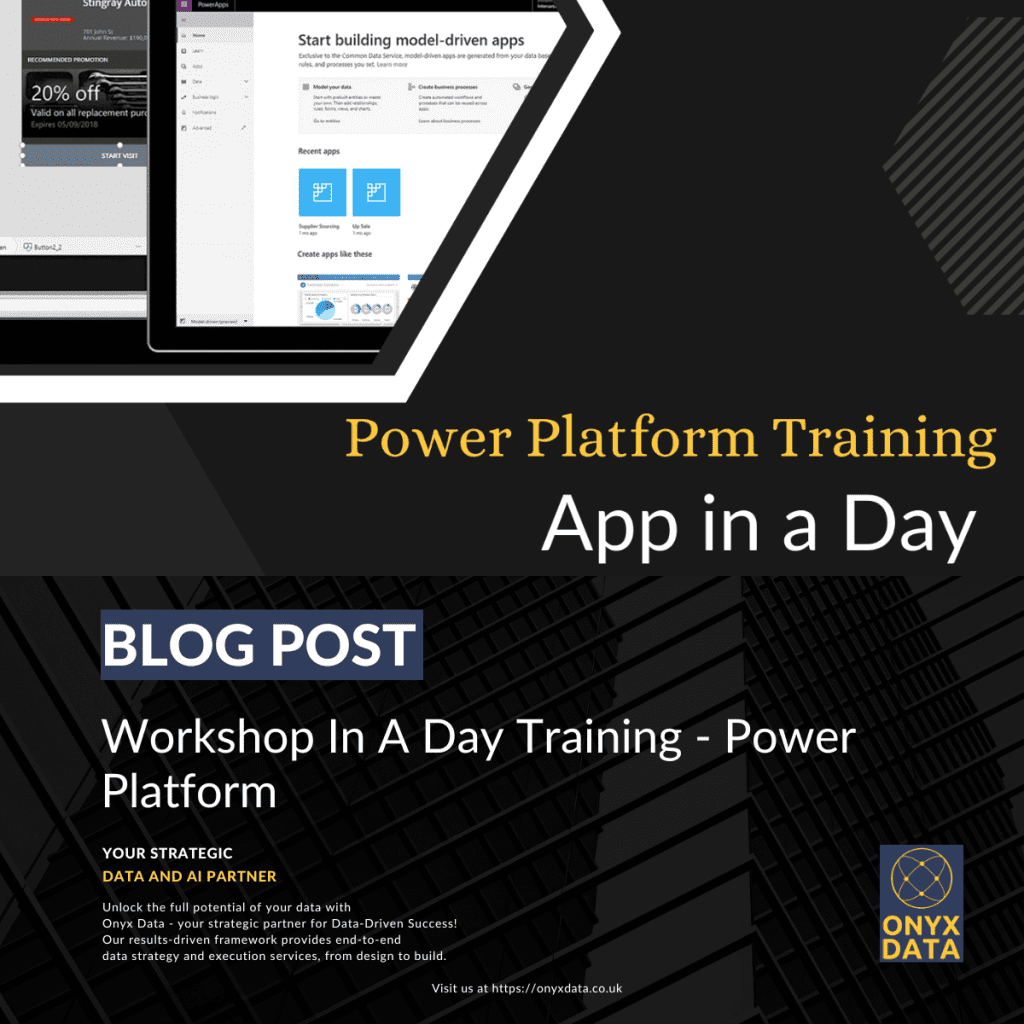
In today’s fast-paced business landscape, the ability to adapt and innovate quickly is crucial. Many organisations face the challenge of finding efficient and cost-effective ways to develop applications tailored to their specific needs without the hassle of extensive coding. Enter Microsoft Power Platform and its remarkable tool, PowerApps, a low-code application builder that empowers individuals and businesses to create custom applications swiftly.

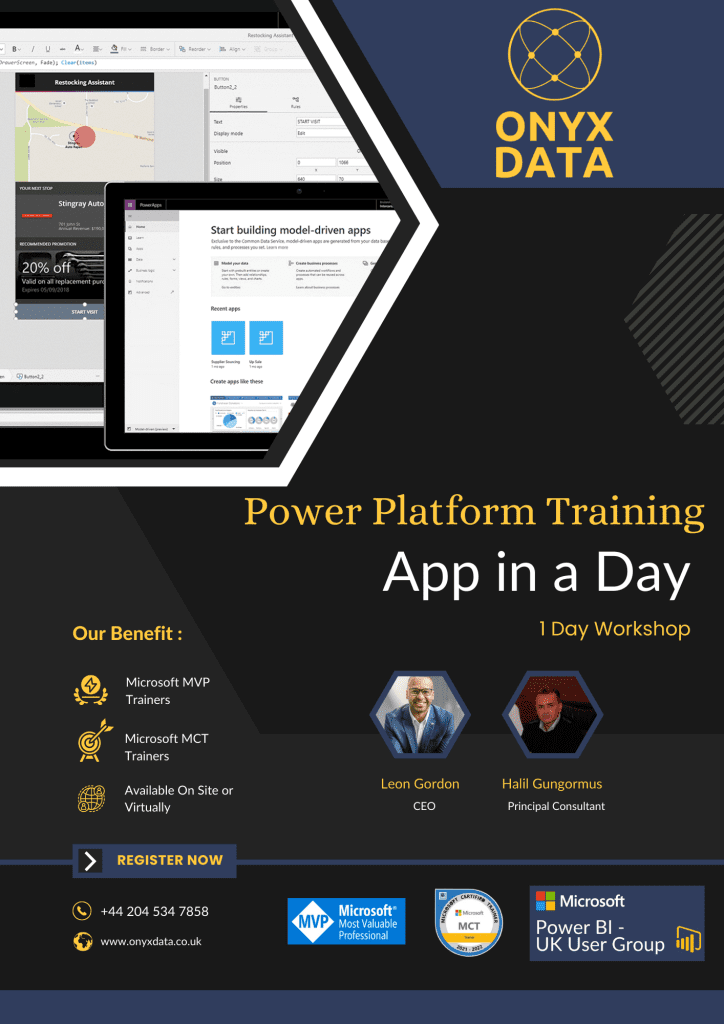
At Onyx Data, we are excited to introduce our “App in a Day” training course, designed to equip you with the skills you need to harness the potential of Microsoft Power Platform and transform your business processes. In this immersive one-day workshop, you’ll dive deep into the world of PowerApps and discover how to build canvas and model-driven applications that cater to your end-users’ unique requirements.

What’s in Store for You?

1. Building Custom Applications: Our course will walk you through the process of building canvas and model-driven applications from the ground up. You’ll learn how to create user-friendly interfaces that enhance productivity and solve real business challenges.

2. Harnessing Common Data Services (CDS): Common Data Services are at the heart of efficient data management within Power Platform. We’ll show you how to use CDS to store and manage crucial business data securely.

3. Powering Efficiency with Microsoft Power Automate: Automation is key to streamlining workflows. You’ll explore how to integrate Microsoft Power Automate to automate approval processes and enable efficient email communication, saving time and reducing errors.

By the end of this training, you’ll be equipped with the knowledge and skills needed to make a significant impact on your daily work. You’ll become a more efficient and effective problem solver, capable of delivering exceptional solutions to your end-users.

Why Wait? Elevate Your Business Now!

Don’t miss this opportunity to unlock the potential of Microsoft Power Platform and PowerApps. Elevate your business to new heights, enhance your productivity, and streamline your processes with our “App in a Day” training course.

Key Highlights of Our Course:

  •  24 Hrs Instructor Led Training by MVP and MCT Instructors

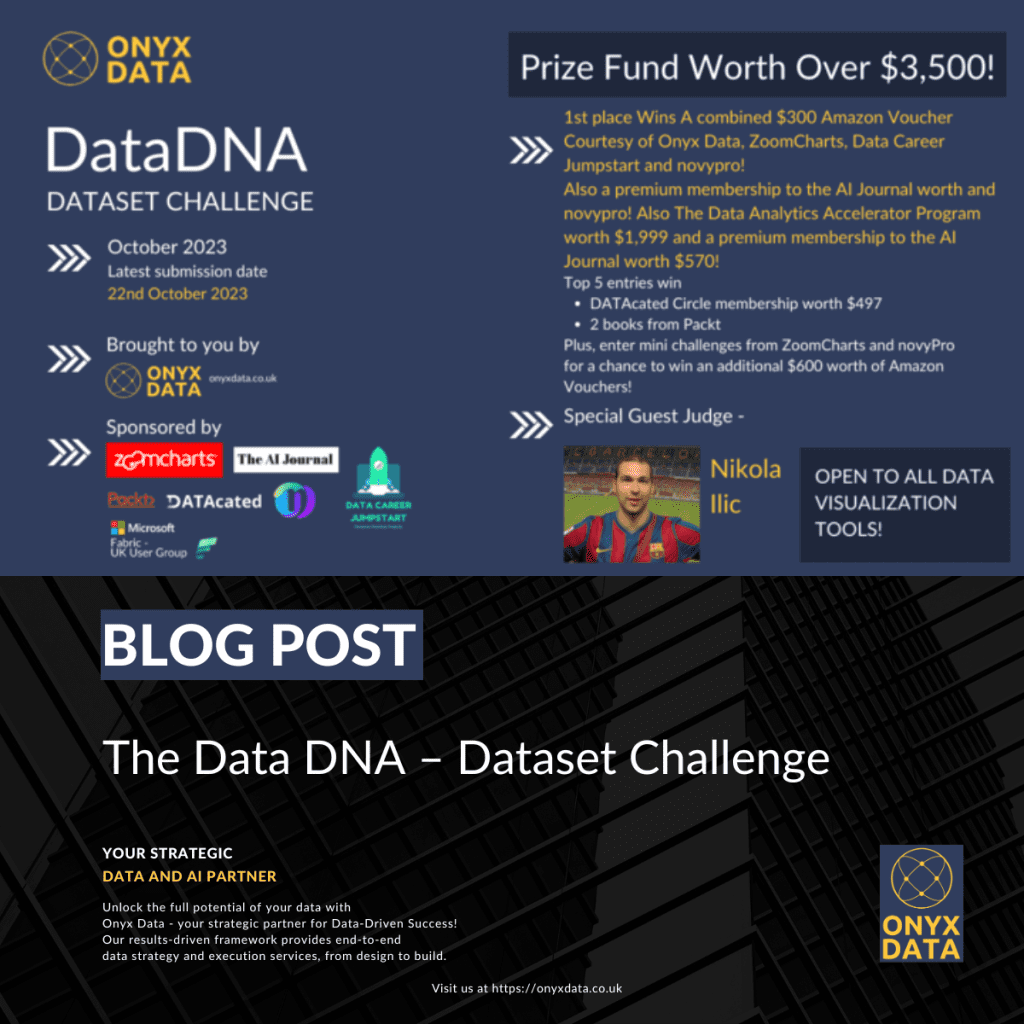
The DataDNA – Dataset Challenge 2023

The DataDNA – Dataset Challenge 20


In today’s data-driven world, harnessing the power of information is more critical than ever before. Data analysis has become a linchpin for decision-making, enabling businesses and individuals alike to gain insights, solve real-world problems, and make informed choices. If you’re passionate about data analytics and visualisation, here’s an exciting opportunity for you: the DataDNA – Dataset Challenge.

Our Mission: Empowering the DataDNA Community

At its core, the DataDNA – Dataset Challenge aims to unite the fields of information design and data analytics, fostering a vibrant community of data enthusiasts. Whether you’re a seasoned professional or a student eager to practice your skills, this challenge provides a platform for you to:

  1. Test Your Data Analysis Skills: Put your data analytical and visualisation competencies to the test by tackling real-world problems.
  2. Showcase Your Expertise: Whether you’re an experienced professional or just starting, this challenge offers a chance to build an impressive portfolio.
  3. Learn Together: Join the DataDNA community and collaborate with like-minded individuals, sharing knowledge and experiences.
  4. Boost Data Visualisation Capabilities: Develop your data visualisation skills, a valuable asset in today’s data-driven job market.
  5. Highlight Data-Driven Decision Making: Demonstrate best practices in data-driven decision-making, a skill in high demand across industries.

Who Can Participate?

The DataDNA – Dataset Challenge is open to both professionals and non-professionals/students:

Professionals:

  • If you are an experienced individual or a team, this is your chance to shine. Showcase your data analytical and visualization skills to potential clients and employers, and earn professional recognition.

Non-Professionals/Students:

  • Are you a student or someone looking to build your data analytics and visualization skills? Use this opportunity to practice your skills and create an impressive portfolio.

Prize Fund Worth Over $2,000!

Participation in the DataDNA – Dataset Challenge comes with a chance to win fantastic prizes, including:

  1. $300 Amazon Vouchers
  2. 2 Data eBooks
  3. Additional Opportunities to Win with ZoomCharts and novyPro Challenges

Award Timeline:

  1. Accepting Entries: September 1 – September 22, 2023
  2. Deadline for All Entries: September 22, 2023
  3. Judging Period: September 23 – September 29, 2023
  4. Award Ceremony Online: September 30, 2023

Selection Criteria:

Entries will be evaluated based on the following criteria:

  1. Visual Design: How well did you visualize the data?
  2. Analytical Skills: Your ability to define key indicators, find insights, and create calculations and metrics.
  3. Narration: Your use of data storytelling techniques to highlight problems and explain solutions.
  4. Tech Innovations: How you use interactive tools, advanced features, and innovative concepts in your work.

How to Submit Your Entry:

To participate in the DataDNA – Dataset Challenge, follow these steps:

  • Follow Onyx Data on LinkedIn (if you’re not already following).
  • Share a LinkedIn post on your profile with your visualization image and tag @OnyxData, @ZoomCharts, @Astrato Analytics, @novyPro, @DATAcated, @The AI Journal, and use the hashtag #dataDNA.
  • In your post, share a single image of your visualization or dashboard.
  • Complete the submission form provided.

For the ZoomCharts Mini Challenge for Power BI, follow these steps:

  1. Register for the ZoomCharts Mini Challenge and receive a Drill Down Visuals Developer License for Power BI.
  2. Create a Power BI report with at least 2 ZoomCharts Drill Down Visuals.
  3. Submit your entry through the provided link.
  4. Follow ZoomCharts on LinkedIn.
  5. Share a LinkedIn post on your profile that includes @ZoomCharts, @OnyxData, and the hashtags #dataDNA and #builtwithzoomcharts.

Judging Criteria for Power BI Reports:

The judging criteria for Power BI reports include:

  1. How easy it is to understand the data.
  2. How user-friendly the report is.
  3. The quality of the report design and its suitability for its purpose.

Resources for Your Journey:

To help you on your data visualization quest, here are some useful resources:

  1. Use-Case Gallery: Explore live demos and download reports created by the ZoomCharts team.
  2. Video Tutorials: Watch engaging video guides on setting up and using visuals.
  3. Documentation: Dive deep into technical details about ZoomCharts visuals.
  4. ZoomCharts Blog: Discover useful tips and tricks for data visualization and report creation.
  5. Visuals Gallery: Explore customization options for Drill Down Visuals.

Prizes:

The creator of the best report will receive a $300 Amazon Voucher from ZoomCharts.

How to Enter NovyPro Mini Challenge:

For the NovyPro Mini Challenge, follow these steps:

  1. Submit the link to your submission on LinkedIn (e.g., https://www.novypro.com/project/telecom-challenge-by-codebasics—dec-2022).
  2. Tag novyPro and Onyx Data in your post (https://www.linkedin.com/company/novypro/).

NovyPro Mini Challenge Judging Criteria:

Your NovyPro Mini Challenge submission will be judged based on:

  1. The design of the cover photo.
  2. The data story flow of the report.
  3. The interactivity of all visuals (visuals should interact with each other).
  4. The overview and description of the dashboard within your novyPro Project submission.

Now that you’re armed with all the information you need, don’t miss this opportunity to unleash your data analysis skills and be part of the DataDNA community. Participate in the Data DNA – Dataset Challenge and take your data visualization journey to new heights!


Find out more about our services here.

Click, read, and hear more about data and artificial intelligence  with our blogs on our website.


Citations

Home

https://onyxdata.co.uk/data-dna-dataset-challenge/


Finding the right data for your needs

Finding the right data for your needs

In today’s data-driven world, datasets have become invaluable resources for various purposes, from research projects to business analytics and beyond. A dataset is essentially a structured collection of data points, often presented in a tabular format, that can be analysed to gain insights, make informed decisions, and develop models or solutions.

Whether you’re a student looking for data for a school project or a professional seeking data to support your work, finding the right dataset can be a pivotal step in your journey. In this blog, we’ll explore the purpose of datasets and answer some common questions about where to find them.

Understanding the Purpose of Datasets

Datasets serve various purposes, depending on the goals of the analysis or research. Here are some key purposes of datasets:

  1. Research: Academics and researchers use datasets to test hypotheses, conduct experiments, and gain insights into various phenomena. For instance, an epidemiologist might use healthcare datasets to analyse disease trends.
  2. Machine Learning and AI: Datasets are crucial for training machine learning models. These models learn from the data and can make predictions, recognise patterns, or classify objects. Image datasets, for example, are used to train image recognition algorithms.
  3. Business Intelligence: Companies use datasets to make data-driven decisions. Sales data, customer information, and market trends datasets can help businesses optimise strategies and increase efficiency.
  4. Education: Students often require datasets for school projects or assignments. Analysing data not only helps students understand concepts better but also enhances their practical skills.

Now, let’s answer some common questions about finding datasets.

How can you find a dataset related to your topic?

Finding a dataset related to your topic requires some research. Start by using data repositories and search engines tailored for datasets. Websites like Kaggle, Data.gov, and GitHub have extensive collections of datasets covering a wide range of topics. You can use keywords related to your topic to narrow down your search.

https://www.kaggle.com/

data.gov

https://onyxdata.co.uk/data-dna-dataset-challenge/

Where can I get free datasets?

Several platforms provide free datasets for various purposes:

  1. Kaggle: Kaggle offers a plethora of datasets contributed by the community. They cover diverse topics and often come with analysis kernels to help you get started.
  2. Data.gov: This is a U.S. government website that provides access to a vast array of government datasets, including economic, environmental, and healthcare data.
  3. UCI Machine Learning Repository: This repository is focused on machine learning datasets and includes datasets suitable for various ML tasks.
  4. GitHub: Many researchers and organisations share datasets on GitHub. You can search for repositories that host datasets using relevant keywords.

How can I access some Google Scholar datasets?

Google Scholar primarily indexes academic papers and articles rather than datasets. However, researchers often include links to datasets in their publications. To find datasets associated with academic papers, search for relevant research papers on Google Scholar and check the paper’s references or supplementary materials for dataset links.

Where can I find large labeled datasets open to the public?

Large labeled datasets are essential for training machine learning models. You can find such datasets on platforms like Kaggle, which often host competitions with substantial labeled datasets. Additionally, academic institutions and research organisations may release labeled datasets related to specific fields of study. Websites like ImageNet and COCO provide labeled image datasets for computer vision tasks.

Where can I find datasets?

Aside from the mentioned platforms, you can also find datasets through academic libraries, government agencies, and domain-specific organisations. Additionally, social media platforms like Reddit and specialised forums often have discussions and recommendations for datasets related to various fields.

Where can I get large public datasets for free?

For large public datasets, consider exploring data repositories maintained by universities, government agencies, and international organisations. Organisations like the World Bank and the United Nations provide access to extensive datasets on various global topics. Additionally, cloud providers like Google Cloud and AWS offer public datasets for analysis through their platforms.

Where can I find large datasets open to the public?

Large datasets open to the public can be found on platforms like Kaggle, GitHub, and data.gov. These datasets cover diverse subjects and cater to different needs, from research and education to business and machine learning. Be sure to check the licensing terms and usage restrictions associated with each dataset to ensure compliance with data usage policies.

In conclusion, datasets play a pivotal role in research, education, and business decision-making. Finding the right dataset for your needs involves exploring various platforms, repositories, and search methods. Whether you’re a student embarking on a school project or a professional seeking data for analysis, the availability of free and accessible datasets has made it easier than ever to harness the power of data for your endeavors.

Find out more about our services here.

Click, read, and hear more about data and artificial intelligence  with our blogs on our website.


Citations

Home

https://onyxdata.co.uk/services/power-bi-performance-improvement-3-wk-workshop/